Cupping Therapy in Harrisonburg, VA
Massage cupping is a clinical soft tissue tool, not a spa add-on. At Refreshing Effects, Tai incorporates cupping, where it reaches what compression-based techniques cannot: deep fascial adhesions, scar tissue, circulatory stagnation, and layers of chronic tension that have been holding for years.
What cupping does that compression cannot.
Every technique in therapeutic massage works through compression: pressing down into muscle tissue, applying friction across the grain of the fiber, using the weight of the hands and forearms to access deeper layers. Compression is effective and forms the foundation of most clinical massage work.
But compression has a limitation. It pushes down. It cannot lift.
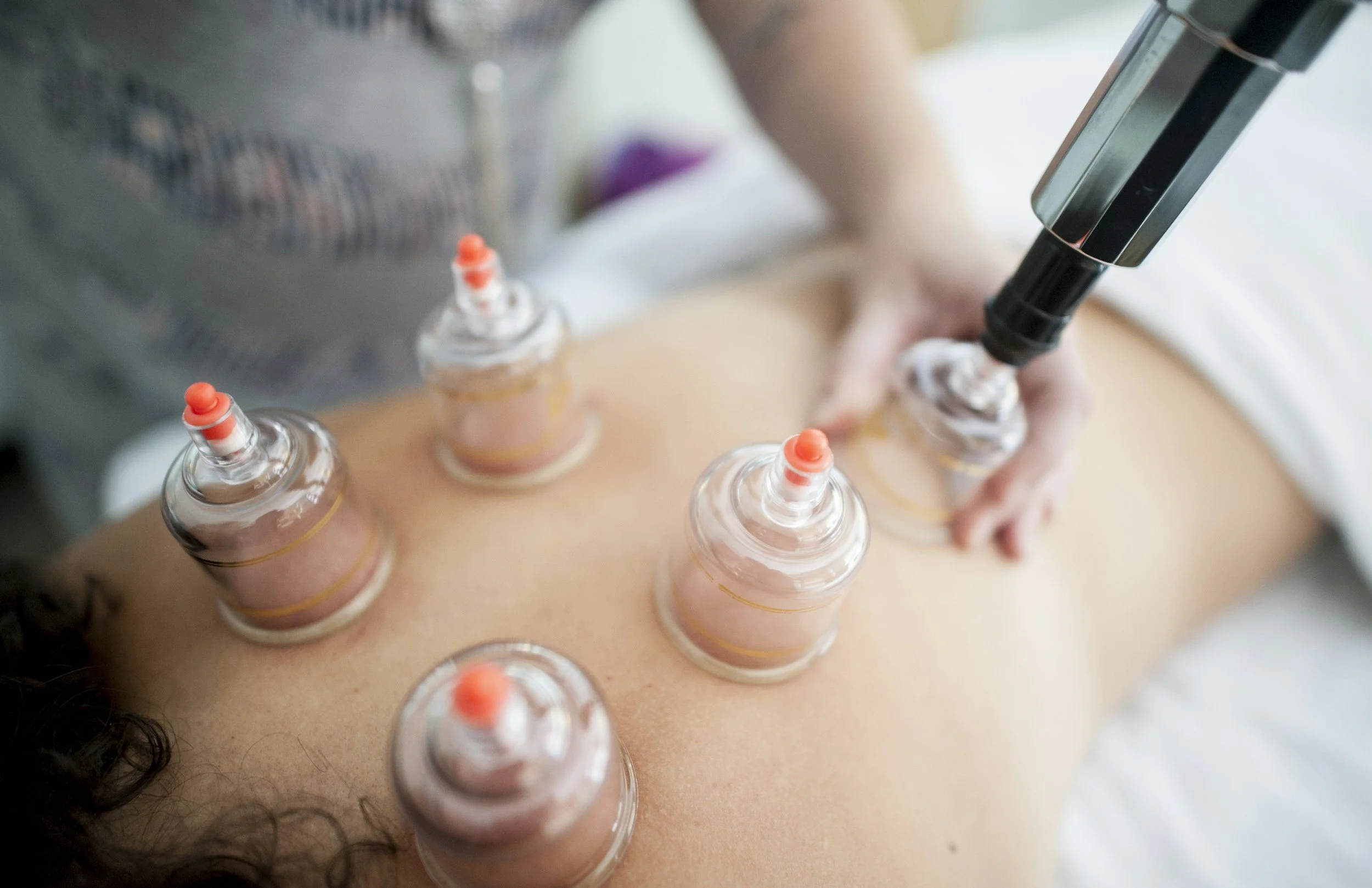
Cupping does something fundamentally different. By creating negative pressure, suction draws the tissue upward into the cup rather than compressing it downward. The effect is a decompression of the tissue, a lifting and separation of layers that have become adhered to each other, a drawing of fresh blood and lymph into areas of chronic stagnation, and a mechanical release of fascial restrictions that compression alone cannot fully access.
For clients who have received skilled massage for years and still carry areas of chronic tension that have not fully released, cupping is frequently the tool that finally reaches them. The approach is different enough from everything that came before that the tissue responds differently. That is the point.
How massage cupping works
The cups used at Refreshing Effects are modern silicone cups rather than the glass and flame of traditional cupping practice. Silicone cups create suction through manual compression of the cup itself, giving Tai precise control over the level of suction applied and allowing her to adjust instantly based on what the tissue needs and what the client is experiencing.
The cups are applied to the skin with oil present to allow controlled gliding. Once suction is established, the cup can be left briefly in place to allow the tissue to respond to decompression, or moved slowly along the muscle and fascial plane in a technique called sliding cupping. The direction, speed, depth of suction, and duration are all clinical decisions Tai makes based on what she is finding in the tissue.
The physiological effects of massage cupping include:
Tissue decompression. The lifting action separates adhered fascial layers, reduces compressive load on underlying nerves and vessels, and creates space in areas where chronic tension has effectively fused tissue planes together.
Increased local circulation. Suction draws blood into the area under and around the cup, increasing local perfusion and delivering oxygen and nutrients to tissue that may have been chronically underserved by circulation due to tension or adhesion.
Lymphatic stimulation. The movement of cups along lymphatic pathways stimulates lymph flow in a manner that complements manual lymphatic drainage and is particularly useful in areas of local stagnation.
Neuromuscular reset. The unusual sensory input of suction can disrupt chronic holding patterns in the nervous system, allowing muscles that have been locked in sustained contraction to release in response to a different type of input.
Scar tissue mobilization. Suction applied to and around scar tissue lifts and moves the adhered collagen fibers in a way that manual compression cannot replicate, gradually improving the extensibility and reducing the restrictive effect of the scar on surrounding tissue.
What cupping addresses clinically
Chronic tension that has not responded to standard massage
Some areas of chronic tension do not fully release under compression-based massage, even skilled compression applied over many sessions. This is often because the restriction is in the fascial layer rather than the muscle itself, or because the tissue has become so accustomed to compression that it no longer responds to it as a novel input. Cupping provides a completely different mechanical experience, and chronically held tissue frequently responds to it in ways it has not responded to compression.
Fascial adhesions and restrictions
When fascial layers that should slide freely against each other become adhered, the resulting restriction limits range of motion, creates pain with movement, and is not fully accessible through compression-based techniques. Cupping's lifting and sliding action separates fascial layers, reduces adhesions, and restores the ability of adjacent tissue planes to move independently. This makes it a useful complement to JFB Myofascial Release in sessions where fascial adhesion is a primary finding.
Scar tissue
Scar tissue is collagen laid down in a disorganized pattern in response to injury or surgery. It is generally less extensible than the surrounding healthy tissue and creates restriction, pulling, and sometimes pain as it matures. Cupping applied to and around scars lifts the adhered tissue, stimulates blood flow into the relatively avascular scar bed, and mechanically encourages the remodeling of scar collagen over time. For clients with significant post-surgical or post-injury scarring, cupping as part of a regular session is one of the more effective ways to progressively reduce the restrictive effect of the scar.
Respiratory restriction and rib tightness
The intercostal muscles, the muscles between the ribs, and the fascial layers of the thorax are notoriously difficult to access with compression-based massage. Direct pressure on the ribs requires careful application and is uncomfortable for many clients at the levels needed to produce meaningful release. Cupping applied along the intercostal spaces and across the thoracic fascia provides a different approach to this region, lifting and mobilizing the tissue without requiring direct compression of the bony structures. Clients with chronic rib tightness, restricted breathing, or upper back tension that lives in the thoracic region specifically often find cupping in this area produces relief that other approaches have not.
Circulatory stagnation
Areas of chronic tension frequently have compromised local circulation. The sustained muscular contraction that characterizes chronic tension reduces blood flow to the affected tissue, limiting the delivery of oxygen and nutrients and the clearance of metabolic waste. This creates a cycle in which poor circulation contributes to ongoing tension, and ongoing tension further compromises circulation. Cupping breaks this cycle by mechanically drawing blood into the area, increasing local perfusion, and stimulating lymphatic clearance of the accumulated waste.
Areas of deep tension difficult to reach with direct pressure
Some clients have areas where direct pressure is uncomfortable enough to trigger guarding, which defeats the therapeutic goal. The nervous system responds to pain with increased muscle contraction, which is the opposite of what a therapeutic session is trying to achieve. Cupping provides access to deep tissue through a mechanism that does not trigger the same protective response. For clients who guard significantly under direct pressure in certain areas, cupping allows Tai to work in those regions effectively without the counterproductive guarding response.
What to expect during a cupping session
If you have not experienced cupping before, knowing what to expect removes the uncertainty that can make any new experience feel bigger than it is.
The sensation. Cupping feels like a pulling or stretching of the skin and superficial tissue, not like pressure going in. Most clients describe it as unusual rather than painful. In areas of significant tension or stagnation, the sensation may be more intense. Tai asks for feedback and adjusts the suction level immediately based on what you are experiencing. You are always in control of what happens in the session.
The sound. When cups are applied and removed, there is an audible pop. This is simply the release of the suction seal. It is louder than most clients expect and completely harmless.
The movement. In sliding cupping, the cups move slowly along the tissue rather than staying in one place. The movement follows the muscle and fascial anatomy in clinically meaningful directions. You may feel a sensation of tissue being lifted and moved along with the cup.
The duration. Cupping is one component of a 90-minute session, not the entirety of it. Tai incorporates cupping where it is most useful within the broader session, typically spending 10 to 20 minutes in cupping work within a session where it is indicated.
After the session. Some clients feel immediate relief in areas where cupping was applied. Others notice a gradual shift over the 24 to 48 hours following the session as the tissue continues to respond to the circulatory and fascial changes initiated during the work. Drinking water in the hours after a session that included cupping supports the clearance of metabolic waste mobilized during the session.
About the marks
Cupping sometimes leaves circular marks on the skin. Since this is the most common concern clients raise about cupping, it deserves a direct and honest explanation.
The marks are not bruises. A bruise is the result of tissue injury, specifically the rupture of small blood vessels, causing blood to pool in the surrounding tissue. Cupping marks are the result of stagnant blood and metabolic waste being drawn toward the surface of the tissue in response to suction. The tissue itself is not damaged.
The color of the marks reflects the degree of stagnation present in the tissue at the time of cupping. Areas with significant stagnation produce darker marks. Areas with healthy circulation produce little to no marking. This is why the same client often shows different marking patterns on different parts of the body, and why marking tends to become lighter and less pronounced with repeated cupping as tissue health improves.
The marks are generally painless. They are not tender in the way a bruise is tender. They resolve on their own, typically within three to seven days, without requiring any special care.
Not all clients develop visible marks. Suction level, duration, and individual tissue characteristics all affect whether marking occurs. Tai can discuss this with you before incorporating cupping if visibility of marks is a concern, given your circumstances.
How cupping fits into a session at Refreshing Effects
Cupping at Refreshing Effects is not a separate service category. It is a clinical tool that Tai uses when it is the right tool, within a therapeutic session that draws from her full range of techniques.
The practical structure is straightforward. Cupping is available as a $25 add-on to any 90-minute booking. The 90-minute session length provides the time needed to meaningfully incorporate cupping alongside the other clinical work that a session involves. Cupping on a 60-minute booking does not allow adequate time to integrate it properly within the session, which is why it is reserved for 90-minute appointments.
Whether cupping is incorporated into your session is a clinical decision Tai makes based on what she finds in the tissue. You do not need to arrive having decided whether you want cupping. She will suggest it if it would serve you, and she will explain why. If you have specific reasons to want cupping incorporated, or specific reasons to prefer it not be used, tell her at the start of the session. That kind of input is useful and always welcome.
Cupping Therapy
Cupping uses negative pressure rather than compression to lift and separate tissue, accessing layers of fascia and creating circulatory changes that hands alone cannot produce. Where pressure pushes down, cupping draws up, releasing adhesions, improving blood flow, and reaching scar tissue in ways that deepen the results of any session.
Add to any session -$25
“Very skilled and knowledgeable about her art.”
— B
Questions before getting started? Learn more:
-
Most cupping marks fade within three to seven days. The timeline depends on the intensity of the marking, individual skin and tissue characteristics, and general circulatory health. Marks from lighter cupping or in areas of healthier tissue may fade in one to two days. More significant marking from areas of pronounced stagnation may take a full week to clear. There is no treatment needed to accelerate fading. Staying well hydrated and avoiding aggressive heat or cold to the area in the days following a session supports natural clearance.
-
Cupping during pregnancy requires case-by-case clinical judgment. Certain areas of the body are contraindicated for cupping during pregnancy, and the approach requires adaptation for the pregnant body. Tai discusses this individually with prenatal clients. If you are pregnant and interested in whether cupping could be incorporated into your prenatal session, contact her before booking to discuss.
-
Yes, and the combination is often clinically synergistic. Cupping addresses the fascial and circulatory layer from above, creating decompression and lifting adhesions. JFB Myofascial Release addresses the same fascial system through sustained direct pressure from below. In a 90-minute session, Tai can use both approaches in a complementary sequence that produces results neither technique achieves as fully on its own.
-
The marks visible on high-profile athletes are the result of the same basic mechanism: suction applied to tissue, drawing stagnant blood and metabolic waste toward the surface. The application used on elite athletes is generally performance recovery focused, applied to maximize blood flow and reduce muscle soreness between competition events. Massage cupping as applied clinically by Tai serves the same physiological mechanisms but in the context of chronic pain, fascial restriction, and therapeutic bodywork rather than acute athletic recovery.
-
Cupping is contraindicated over inflamed, broken, sunburned, or compromised skin, and in areas affected by certain skin conditions. Tai reviews the condition of the tissue before applying cups in any area and avoids cupping where it is not appropriate. If you have a skin condition you are concerned about, mention it at intake and she will advise.
Cupping therapy near Harrisonburg and the Shenandoah Valley.
Refreshing Effects is located at 1171 S. High St., Suite 110, in Harrisonburg, Virginia, providing therapeutic bodywork, including massage and cupping for clients throughout Harrisonburg, Rockingham County, Augusta County, Staunton, Waynesboro, and the broader Shenandoah Valley region.
Massage cupping applied as a genuine clinical soft tissue technique, rather than as a spa trend, is not widely available in the Harrisonburg area. Clients who have searched for cupping therapy in Harrisonburg, cupping massage near me, or therapeutic bodywork in the Shenandoah Valley and have been looking for clinical rather than spa-oriented care consistently find that Tai's approach and experience represent something different from what is typically offered locally.
Cupping is available as an add-on to 90-minute sessions at Refreshing Effects. New clients are accepted on a limited basis.
Add cupping to your next session.
If you have chronic tension that has not fully released through other approaches, scar tissue affecting your mobility, or areas of the body that have been holding for years without yielding, a 90-minute session with cupping incorporated may be the clinical turning point.
Cupping is available as a $25 add-on to any 90-minute booking. Book your session below and mention your interest in cupping in the intake notes. Tai will assess whether it is the right addition for your session and incorporate it where it will do the most good.