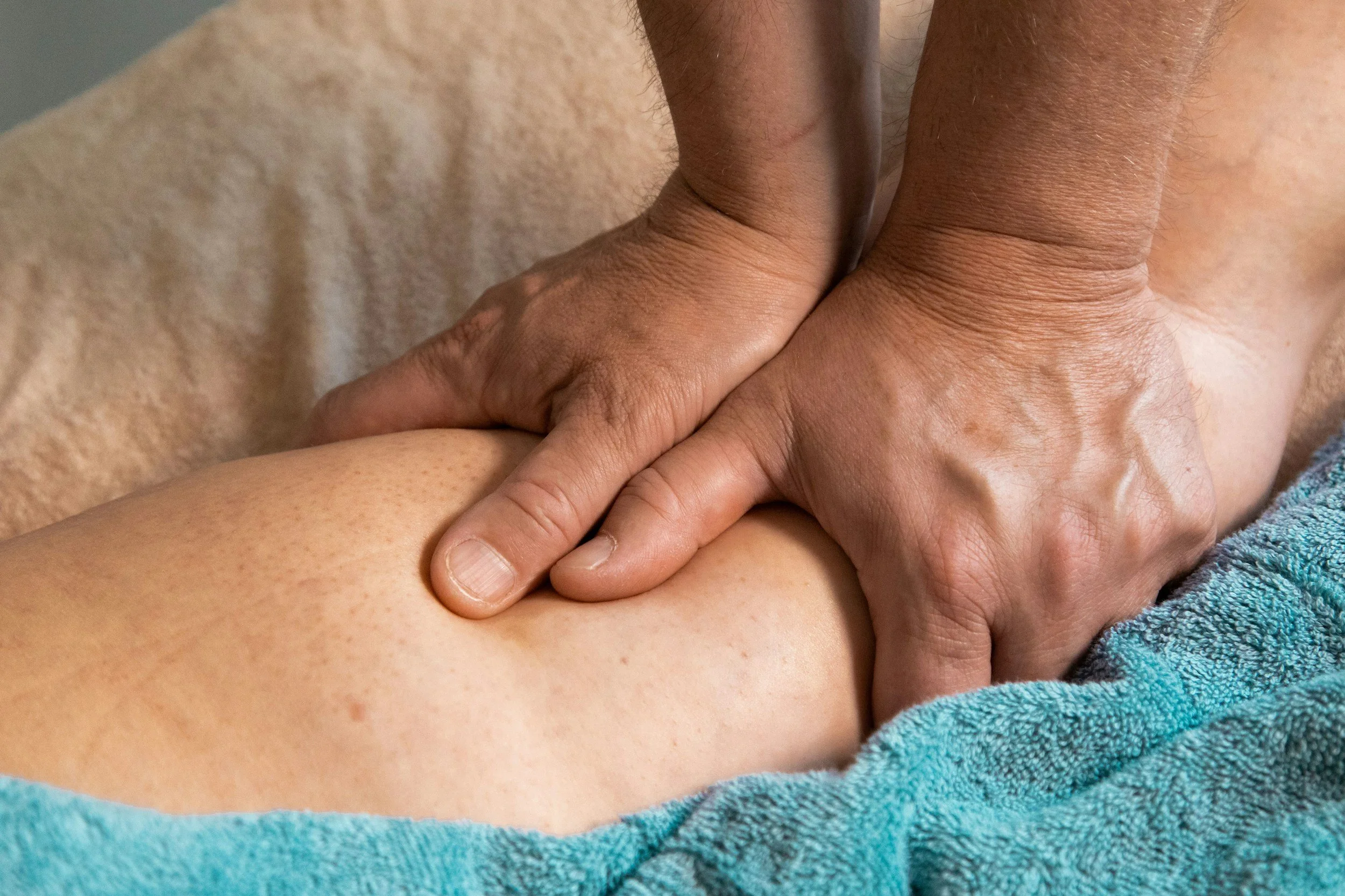
Deep tissue massage in Harrisonburg, VA.
Clinical deep tissue work for chronic neck pain, back pain, sciatica, fibromyalgia, and the kind of persistent tension that has outlasted every other attempt to address it. At Refreshing Effects, deep tissue is not defined by how hard the pressure is. It is defined by what it accomplishes.
What clinical deep tissue massage actually means.
Deep tissue massage is one of the most frequently searched and most frequently misunderstood terms in therapeutic bodywork. The misunderstanding usually goes in one of two directions.
The first is that deep tissue simply means harder. It is a standard massage turned up in intensity, where the value is delivered through the pressure itself, and more is always better. This is not accurate, and practitioners who work from this premise often leave clients sore, guarded, and no better off than before.
The second misunderstanding is the opposite: that deep tissue is just a marketing term with no real clinical meaning, that all massage is essentially the same at varying depths. This is also not accurate.
Clinical deep tissue massage is defined by what it targets and how, not exclusively by how much pressure is applied. It works with the deeper layers of muscle, the fascia surrounding and connecting those muscles, and the adhesions and restrictions that develop in those layers over time as a result of injury, chronic tension, repetitive movement, or postural strain. The techniques used, including sustained compression, cross-fiber friction, myofascial release, and trigger point work, are applied with specific clinical intent to break down adhesions, restore tissue mobility, and address the patterns maintaining the pain, not just the pain itself.
At Refreshing Effects, deep tissue work is always clinical. It begins with an assessment. It follows a clinical rationale. It integrates other techniques, including JFB Myofascial Release, lymphatic drainage, cupping, and reflexology, to serve the outcome. And it ends with a result that the client can feel, not just during the session but in the hours, days, and subsequent weeks after.
How Tai approaches deep tissue work.
Twenty years of clinical practice teach things that training alone cannot. Chief among them: the location of pain is rarely the location of the problem.
Chronic neck pain that has persisted for years is almost never caused only by what is happening in the neck. It originates in a pattern, a combination of postural habit, muscular compensation, fascial restriction, and often an older injury or event that set the pattern in motion. Addressing only the neck produces temporary relief because it treats the symptom. Addressing the pattern produces resolution because it treats the cause.
This is how Tai thinks about every deep tissue session. Before applying pressure, she assesses. She looks at how the client holds themselves. She asks about history, what activities aggravate the pain, what has been tried, what has helped, and to what degree. She palpates the tissue to identify where the restriction actually lives, which is frequently not where the client reports the most pain. And then she works.
Her approach to deep tissue is also shaped by her advanced JFB Myofascial Release training, which has given her a fundamentally different understanding of the fascial system and how it contributes to the muscular restriction that most people experience as deep tissue tension. In many sessions, what appears to be a deep muscle problem is partly or primarily a fascial problem. Recognizing which is which and responding accordingly is what separates a clinical deep tissue practitioner from one simply applying heavy pressure.
Tai does not follow a protocol. She follows the tissue. That is not a marketing phrase. It is a description of how 20 years of specialized training change the way you work. Deep tissue is part of the signature session. Learn more about the Refreshing Effects Session here.
“After a massage from Tai, I feel better than I have in years. I practically floated out of her establishment!”
— Happy Client

What deep tissue massage addresses.
Chronic neck and shoulder pain
Chronic neck and shoulder pain is the single most common presentation in Tai's practice. It is also one of the most complex, because the neck is at the intersection of the postural, structural, and neurological systems in a way that few other body regions are.
Persistent neck and shoulder tension typically involves a combination of muscular holding patterns, fascial restriction through the cervical and thoracic spine, compression of the suboccipital structures at the base of the skull, and often a component of jaw tension that most clients do not initially connect to their neck pain. Tai's clinical approach addresses all of these layers.
The traps, the levator scapulae, the scalenes, the suboccipitals, the rhomboids, the pectorals, and the deep cervical flexors all play roles in chronic neck and shoulder pain. Effective deep tissue work moves through all of them, identifying where the restriction is densest and working systematically to release it. For many clients, the experience of having a practitioner find and address the actual source of their tension rather than the reported location of their pain is genuinely revelatory.
For neck pain with a headache component, see also the myofascial release page, where Tai's advanced cranial work is described in more detail.
Low back pain
Low back pain is among the most prevalent and most undertreated conditions in the adult population. Most people manage it rather than resolve it, alternating between pain medication, chiropractic adjustments, and periods of rest, with varying degrees of temporary relief.
The soft tissue component of low back pain, specifically the quadratus lumborum, the lumbar erectors, the thoracolumbar fascia, the deep hip rotators, and the sacroiliac ligaments, is frequently underaddressed in conventional treatment. Physical therapy often focuses on strengthening and movement without adequately addressing the tissue restrictions that are limiting both movement and pain experience. Chiropractic care addresses joint alignment without necessarily addressing the muscular and fascial tension that pulls the joint back out of alignment after adjustment.
Clinical deep tissue massage addresses the soft tissue layer directly. Tai works through the posterior chain systematically, identifying the specific muscles and fascial layers that are maintaining the restriction pattern, and releasing them in a sequence that respects the compensation patterns the body has developed over time. Releasing the presenting restriction without addressing the compensation that evolved around it produces incomplete results. Tai's assessment process identifies both.
The research supporting massage therapy for chronic low back pain is substantial. A 2020 Cochrane review found that massage therapy produced moderate-quality evidence of effectiveness for chronic low back pain, with the strongest results for clinical approaches combining multiple techniques applied over a course of sessions.
Sciatica and piriformis syndrome
Sciatic pain, the radiating pain, numbness, or tingling that travels from the low back through the hip and down the leg, is one of the most debilitating common pain presentations. It is also one where soft tissue work frequently succeeds where other approaches have only partially helped.
True disc-related sciatica, caused by a herniated disc compressing the sciatic nerve root, has a structural component that massage cannot address directly. However, a significant proportion of clients who present with sciatic symptoms do not have disc pathology as the primary driver. Their pain is caused by soft tissue compression of the sciatic nerve, most commonly by the piriformis muscle in the deep hip, by the hamstring attachment at the ischial tuberosity, or by fascial restriction through the lumbosacral region.
This distinction matters clinically because soft tissue compression of the sciatic nerve responds very well to targeted deep tissue and myofascial work. Piriformis syndrome, in particular, is often dramatically improved by specific deep tissue work to the piriformis and surrounding hip rotators, combined with myofascial release of the thoracolumbar and lumbosacral fascia.
Tai assesses each client's sciatic presentation to determine whether the pain is likely soft tissue driven and, if so, develops a session approach specifically targeting the compressive structures. Many clients who arrive having been told their sciatica will require long-term management leave after a course of sessions with meaningful, sustained improvement.
Fibromyalgia
Fibromyalgia is a condition characterized by widespread musculoskeletal pain, fatigue, cognitive symptoms, and heightened sensitivity to pressure throughout the body. Working with fibromyalgia clients requires specific clinical knowledge because the standard deep tissue approach, heavy pressure applied to areas of tension, frequently exacerbates fibromyalgia symptoms rather than relieving them.
Tai approaches fibromyalgia with a graduated, carefully calibrated technique that prioritizes the neurological response over the mechanical goal. The aim in early sessions is to provide meaningful input to the tissue without activating the sympathetic nervous system, which in fibromyalgia clients is often chronically elevated and responds to aggressive pressure with flares of pain and fatigue.
Over the course of sessions, as the nervous system becomes more regulated and the tissue more responsive, the depth and specificity of work can be gradually increased. Most fibromyalgia clients working with Tai on an ongoing basis report meaningful reduction in widespread pain, improved sleep, and reduced fatigue, with each session building on the cumulative work of the sessions before it.
This is a population where patience and clinical precision matter far more than pressure, and where a long-term therapeutic relationship produces results that a single-session approach cannot.
Sports and activity-related tension
The body that is regularly physically active accumulates a specific kind of tissue restriction: the adhesions and myofascial holding patterns that develop around repetitive movement, the scar tissue from minor injuries that were never fully addressed, the chronic tightening of specific muscle groups that are worked hard and stretched insufficiently, and the cumulative compression that builds in load-bearing joints over years of use.
Runners, cyclists, farmers, construction workers, healthcare providers who spend hours on their feet, parents of young children, and anyone else whose daily life places sustained physical demand on the body benefit from regular clinical deep tissue work that addresses these patterns before they become injuries.
Tai works with active clients throughout the Harrisonburg area, developing session approaches that address the specific demands and patterns of their activity. She is not a sports massage practitioner in the competitive athletic support sense. She is a clinical bodywork practitioner who understands how physical demand shapes tissue and how to address what accumulates over time.
Postural tension from desk work and screens
The posture of modern knowledge work, forward head, rounded shoulders, compressed thoracic spine, shortened hip flexors, weakened glutes, is creating a generation of bodies with a distinctive and increasingly prevalent pattern of chronic tension.
Forward head posture adds a significant load to the cervical spine for every inch the head translates forward from its neutral position. Hours at a keyboard shorten and tighten the pectoral and anterior shoulder muscles while the rhomboids and mid-traps become chronically lengthened and weak. Hip flexors shortened from prolonged sitting compress the lumbar spine and contribute to both low back pain and hip restriction.
Tai sees this pattern daily in her Harrisonburg practice. Effective clinical deep tissue work for this population addresses both sides of the equation: releasing the shortened, overworked anterior structures and the compensating tension in the posterior chain, while also providing the myofascial work needed to restore the fascial balance that postural change has disrupted. Sessions for this population often produce the most dramatic immediate relief of any presentation, because the tissue has rarely been addressed with the specificity and depth it needs.
Headaches rooted in the neck and upper back
Not all headaches are neurological. A significant proportion of chronic headaches, particularly those described as tension headaches, are driven by muscular and fascial restriction in the cervical and suboccipital region, the jaw and temporomandibular area, and the upper trapezius. These headaches often begin in the neck or shoulders before migrating forward, respond to heat or pressure on the neck, and are typically worsened by stress and prolonged sitting.
Clinical deep tissue work addressing the posterior cervical muscles, the suboccipitals, the upper traps, the scalenes, and the levator scapulae produces meaningful and often dramatic reduction in tension headache frequency and intensity for many clients. When the headache pattern has a cranial component as well, Tai's JFB fascial cranium work addresses the meningeal layer that deep tissue alone cannot reach.
Clients who have managed chronic tension headaches with medication for years are often surprised by how much of the headache pattern is driven by soft tissue that has simply never been specifically addressed.
Hip and gluteal tension
The gluteal complex, the gluteus maximus, medius, and minimus, along with the deep hip rotators, including the piriformis, the obturators, and the gemelli, is one of the most chronically overlooked regions in general massage practice. These muscles bear significant load in standing, walking, running, and sitting, and develop dense, chronic restriction patterns that contribute to low back pain, hip pain, knee pain, and sciatica.
Tai addresses the hip and gluteal region with specific clinical attention, working through the layers of the gluteal complex to release the adhesions and restrictions that contribute to pain throughout the posterior chain. Many clients report that specific work in this region produces relief in seemingly unrelated areas, including the low back and the knee, because the hip is often the origin point of a restriction chain that expresses itself elsewhere.
Tension that returns quickly after another massage
This is perhaps the most common reason new clients seek out Refreshing Effects. They have been receiving massage regularly, possibly for years, but the relief lasts two or three days before the tension returns to its baseline. The sessions feel good, but the effect does not hold.
When tension returns this quickly, the cause is almost always one of two things. Either the work is addressing only the surface layer of muscle tension without reaching the fascial restriction that is maintaining it, or the sessions are treating the symptom without addressing the underlying pattern that generates it. In either case, the tissue reverts because the root driver has not been touched.
Tai's clinical assessment process is specifically designed to identify what is maintaining the pattern. For clients who have plateaued with other practitioners, this assessment is often where the path forward becomes clear.
Deep tissue is part of the signature session. Learn more about the Refreshing Effects Session here.
“Tai is the best! Wouldn’t go to anyone else!”— Happy Client

What to expect in a deep tissue session at Refreshing Effects.
A session at Refreshing Effects begins with a brief clinical conversation before any bodywork begins. Tai asks about your current presentation, your history, what you have tried, and what you are hoping to address. This is not a formality. The information directly shapes how the session proceeds.
She palpates the tissue before beginning significant work, identifying areas of restriction that may not correspond to where the client reports pain. This assessment phase is often where clients first notice that their complaint is being taken seriously in a different way than they have experienced elsewhere.
The session itself moves through the areas of greatest clinical relevance in a sequence that makes physiological sense, not necessarily the sequence the client might expect. Tai may spend significant time working on a region that seems unrelated to the presenting complaint before addressing the complaint area directly. This is intentional. The tissue that is generating the pain is often not the same tissue that is maintaining the pattern that generates it.
Communication throughout the session is welcomed and useful. If the pressure is productive and engaging, say so. If it is creating pain that makes you want to tense against it, say that too. The feedback shapes the work.
After the session, Tai often shares observations about what she found and, if relevant, what she recommends addressing in future sessions. Most clients rebook before leaving.
A note on pressure.
The most common misconception about deep tissue massage is that more pressure is better. It is not. Pressure is a tool, and like every tool, its value depends entirely on how precisely it is applied.
Heavy, undifferentiated pressure applied to a large area is not deep tissue massage in any meaningful clinical sense. It is compression. It may feel like something is happening, and the soreness that follows may feel like evidence that something productive occurred. But soreness after a massage is not evidence of therapeutic benefit. It is evidence of tissue trauma. Feeling sore is not the same as getting better.
The pressure Tai uses in deep tissue work varies considerably within a single session, depending on what the tissue is presenting. She uses sustained moderate pressure to address broad fascial restriction. She uses focused, specific pressure to address trigger points and adhesions. She uses very light, sustained pressure for myofascial release. And she uses no pressure at all in areas where cupping or lymphatic work is the more appropriate tool.
The depth of a session at Refreshing Effects is determined by what the tissue needs, not by a client's expectation of intensity. Clients who arrive expecting the hardest massage they have ever had sometimes leave having received the most effective one, at a depth they would not have predicted, addressing patterns they had not expected to feel resolved.
How does deep tissue work integrate with other clinical techniques.
One of the most significant advantages of working with a practitioner who has 20 years of training across multiple clinical modalities is that deep tissue work does not have to be the only approach in a session.
In practice, Tai rarely performs a session that is exclusively deep tissue compression from start to finish. She integrates:
JFB Myofascial Release, where the restriction is primarily fascial rather than muscular, or where sustained release of the fascial layer is needed before deeper muscle work can be effective.
Lymphatic drainage techniques in areas of local inflammation or circulatory stagnation that are contributing to the tissue's inability to release under compression alone.
Cupping in areas of deep adhesion, chronic stagnation, or scar tissue, where lifting the tissue produces a different and complementary result to compressing it.
Reflexology is an integrative closing technique in sessions where systemic nervous system regulation supports the work that has been done in the tissue.
The session is always built around what the specific body in the room needs on that specific day. That requires having access to multiple techniques and the clinical judgment to know which to apply when. This is what Tai brings to every session, and it is what produces results that exceed what any single technique applied in isolation typically achieves.
Learn about the Refreshing Effects Session, where all of these techniques are available within a single appointment. We offer packages and memberships if you are interested in getting the most out of your care.
Questions before getting started? Learn more:
-
This depends on how long the condition has been present and how complex the underlying pattern is. Many clients notice meaningful improvement after a single session. Sustained resolution of chronic patterns typically requires a series of sessions, with most clients working through a significant shift over 4 to 8 appointments. Conditions that have been present for years generally require more sessions than recent-onset pain. Tai gives each client a realistic expectation after the first session based on what she finds in the assessment.
-
Some mild soreness in the 24 to 48 hours following a clinical deep tissue session is normal, particularly after the first session or after work in an area that has not been specifically addressed before. The soreness should feel similar to the soreness of a productive workout rather than the sharp pain of injury. Significant pain following a massage session is not a sign of effective work. It is a sign that the depth of pressure exceeded what the tissue was ready to receive. This does not happen at Refreshing Effects because Tai calibrates the work to what the tissue is presenting, not to a standard of intensity.
-
Swedish massage uses lighter pressure, longer gliding strokes, and a general protocol designed to promote relaxation and broad circulatory improvement. Deep tissue massage uses more focused pressure, slower strokes, and specific techniques targeting the deeper layers of muscle and connective tissue. At Refreshing Effects, the Refreshing Effects Session replaces both of these as separate menu items. The session draws from the full range of clinical techniques, including both Swedish-derived strokes and deep tissue work, applied in a combination that serves each client's clinical needs.
-
Deep tissue massage addresses the soft tissue component of sciatic presentations and can be meaningfully helpful even when disc pathology is present. Even in true disc herniation, the surrounding musculature typically develops significant spasm and guarding that contributes substantially to the pain experience. Releasing this soft tissue component reduces the overall pain even when the structural disc issue cannot be addressed through massage. Tai discusses each client's imaging and diagnostic history at intake and adjusts her approach accordingly. She does not apply deep pressure directly to an acutely herniated disc presentation and refers clients to their medical provider when the clinical picture suggests it is needed.
-
For active chronic pain, weekly sessions in the early phase of treatment produce the most meaningful cumulative improvement. As the condition stabilizes, most clients transition to bi-weekly, then monthly maintenance sessions. The frequency that makes the most sense for your specific situation is something Tai will discuss with you after the first session, based on the severity and duration of your condition and how your body responds to treatment.
-
Yes, with the caveat that the experience you are describing is a real and common outcome of deep tissue massage applied without adequate clinical assessment. When pressure is applied at a depth that exceeds what the tissue is ready to receive, or in a sequence that does not account for the body's compensation patterns, the session can produce a temporary increase in pain and tension. Tai's clinical assessment process and her communication approach throughout the session are specifically designed to prevent this. If you arrive with this history, tell her. It is useful clinical information that shapes how she works with you.
-
Deep tissue massage during pregnancy is modified significantly from standard deep tissue work. Certain areas and techniques are contraindicated during pregnancy, and the positioning and pressure used must be adapted for the pregnant body. Tai holds her Nurturing the Mother certification and works with pregnant clients regularly, but pregnancy massage at Refreshing Effects is its own specialized service rather than a modification of the standard deep tissue session. See the Pregnancy, Labor and Postpartum page for full details.
Deep tissue massage near Harrisonburg and the Shenandoah Valley.
Refreshing Effects is located at 1171 S. High St., Suite 110, in Harrisonburg, Virginia, providing clinical deep tissue massage and therapeutic bodywork for clients throughout Harrisonburg, Rockingham County, Augusta County, Staunton, Waynesboro, Broadway, Bridgewater, Elkton, and the surrounding Shenandoah Valley region.
Clients searching for deep tissue massage in Harrisonburg VA, massage for chronic neck pain in Harrisonburg, massage for back pain in the Shenandoah Valley, massage for sciatica near Harrisonburg, or massage for fibromyalgia in Virginia consistently find that the clinical depth and specificity of Tai's approach produces results that general massage has not. Her 20 years of specialized training in clinical bodywork, JFB Myofascial Release, and a range of complementary techniques means that a session at Refreshing Effects is not a deeper version of a standard massage. It is a fundamentally different clinical experience.
New clients are accepted on a limited basis. Tai's schedule fills in advance. Reaching out early is recommended.
Book a deep tissue session in Harrisonburg.
If you have been managing chronic neck pain, back pain, sciatica, fibromyalgia, or persistent tension that has not fully responded to other treatment, a clinical deep tissue session with Tai is where the work goes deeper than you have been before.
Not in terms of pressure. In terms of precision.